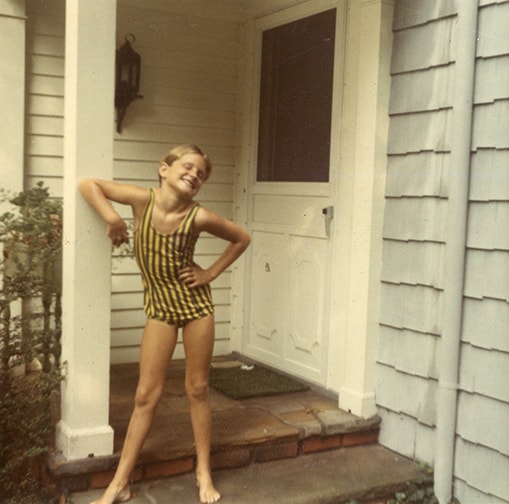
Maggie Taylor is a contemporary artist based on the edge of a sun-drenched prairie outside Gainesville, Florida, a landscape of cows, alligators, and migratory birds. Born in Cleveland, Ohio, in 1961, she moved to Florida at age eleven.
After earning a degree in philosophy from Yale University and a master’s degree in photography from the University of Florida, she began exploring digital imaging in the 1990s, when the medium was still new. She was among the first artists to adopt Photoshop as a fine art tool, drawn to its potential for layered digital photomontage.
Her work has been widely exhibited and is held in numerous museum collections, including The Center for Creative Photography, Tucson; George Eastman Museum, Rochester; Harn Museum of Art, Gainesville; Harry Ransom Center, The University of Texas; The High Museum of Art, Atlanta; Museum of Fine Arts, Houston; Ogden Museum of Southern Art, New Orleans; Princeton University Art Museum; Harvard Art Museums; The Nelson-Atkins Museum of Art; The Cleveland Museum of Art; and The Santa Barbara Museum of Art.
internal logic
I think of the work as visual storytelling, though the stories are never quite complete. Each image is a kind of riddle or open-ended poem—something to enter rather than solve. What may look surreal often follows its own internal logic. The images move according to dream logic: associative, symbolic, and quietly coherent beneath the surface.
People sometimes see autobiography in the work, and they’re right in a way. The scenes grow out of lived experience, though the connections are disguised and rarely literal.
The work is deeply rooted in nineteenth-century photography. I use tintypes, daguerreotypes, and ambrotypes from my personal collection—anonymous portraits made in the earliest decades of the medium. Freed from their original identities, these figures become collaborators in new narratives. There’s a particular tension in letting historical artifacts wander into imagined worlds.
I want the images to feel at once whimsical and quietly unsettling—grounded in the textures of early photography while opening onto something speculative. Ideally, the viewer steps into the middle of a story already in motion, sensing that something began before them and will continue after they leave.
process and materials
The process began with physical construction. From the late 1980s through the mid-1990s, I built three-dimensional collages from found objects and historical imagery and photographed them with a 4x5 camera. It was expensive, slow, and unforgiving. A small change meant starting over..
As digital tools emerged, the mechanics shifted but not the impulse. Today my main tools are a flatbed scanner, a cell phone camera, and the computer. I work primarily with scanned nineteenth-century photographs from my collection, along with self-made imagery, scanned fragments, and photographs of small objects gathered in the studio—natural specimens such as insects and seed pods, bits of fabric, mechanical parts, tiny sculptures and toys. The studio functions as a contemporary cabinet of curiosities: layered, curious, and full of unlikely companions waiting to be recombined.
Using Photoshop and related software, I assemble layered digital photomontages that retain the tactile logic of physical collage while existing entirely in a digital space. I aim to construct images that feel like spaces you can step into—coherent at first glance, then quietly strange.
In recent years, I have incorporated AI-assisted image generation into certain stages of the process. Used selectively and under my direction, these tools extend the range of visual possibilities while remaining integrated within the larger structure of the work. The images are not algorithmic outputs but carefully shaped constructions formed through editing, layering, and sustained revision. The technology serves the idea.
Each piece develops slowly over months of collecting, scanning, photographing, adjusting, and rethinking. I complete a limited number of works each year. Slowness is part of the method.
Finished works are produced as archival inkjet prints in my studio, using museum-quality papers and pigment-based inks designed for longevity. The goal is to create physical objects that carry forward photography’s material history while fully inhabiting its .
monographs
- Adobe Photoshop Master Class: Maggie Taylor's Landscape of Dreams, Peachpit Press, Berkeley, 2005
- Solutions Beginning with A, Modernbook Editions, Palo Alto, 2007
- Alice's Adventures in Wonderland by Lewis Carroll, Modernbook Editions, Palo Alto, 2008
- Album, Edizioni Siz, Verona, Italy, 2009
- No Ordinary Days, University Press of Florida, 2013
- Through the Looking-Glass, and What Alice Found There by Lewis Carroll, Moth House press, 2018
- Internal Logic, Moth House press, 2022
links
- The Quirky World of Maggie TaylorPodcast by Suzanne Fritz-Hanson and Michael Rubin
- Jerry & Maggie: This Is Not PhotographyVimeo
- Making Images is a Way of LifeArticle by Douglas Eby
- Trough The Looking-Glass BookMaggie Taylor talking about her book Through The Looking-Glass and What Alice Found There
- No Ordinary Days BookMaggie Taylor talking about her book No Ordinary days
- Maggie Taylor Seeing Things at Artists' MarketJeffrey Price talking about Maggie Taylor from an opening
- Maggie Taylor for VERVE GalleryVimeo
